

Sometime last fall, in a cafe near the Bund in Shanghai, a woman picked up her phone. She did not open an app, nor did she scroll, read the reviews, compare restaurants, or check the delivery time. Instead, she spoke the following nine words: “Order my usual lunch; deliver it 20 minutes later.”
The phone paused for about three seconds. An agent named Xiaomei, built by Meituan, China’s largest food-delivery super app, read the word “usual.” It knew the restaurant where the woman always ordered her food and the delivery window that she normally wanted. It applied her preferences, paid for her, tracked the driver, and pushed the arrival back by exactly 20 minutes, because that was what she had asked for. She never clicked. She had no reason to check. Of course it would come. It always did.
That convenience is the end of the internet as we have known it.
For 25 years, the consumer internet ran on one assumption: Humans click. We search, compare, read reviews, abandon our carts, and get retargeted by the shoes that we looked at once but never bought. Every trillion-dollar company in Silicon Valley was built around that friction. Google monetized the search, while Amazon did the same for the comparison and Meta for the scroll.
Performance marketing, the search-and-social ads designed to make you click, exists for that one reason. And it’s massive: more than $600 billion of the $1 trillion-plus that the world spends on ads each year.
Now those clicks are slowly but surely going away. An agent reads the reviews for you, files the return for you, knows which shoes you already own, and then declines to show you the ad. The whole marketing funnel built for humans suddenly becomes obsolete.
A few weeks ago, I published an essay called Coase vs. Claude. I argued that AI agents are pushing a 90-year-old economic theory to its breaking point. Then my readers, from Berlin to Brisbane to Singapore to Mountain View, wrote back to tell me I had it only half right. They meant it literally.

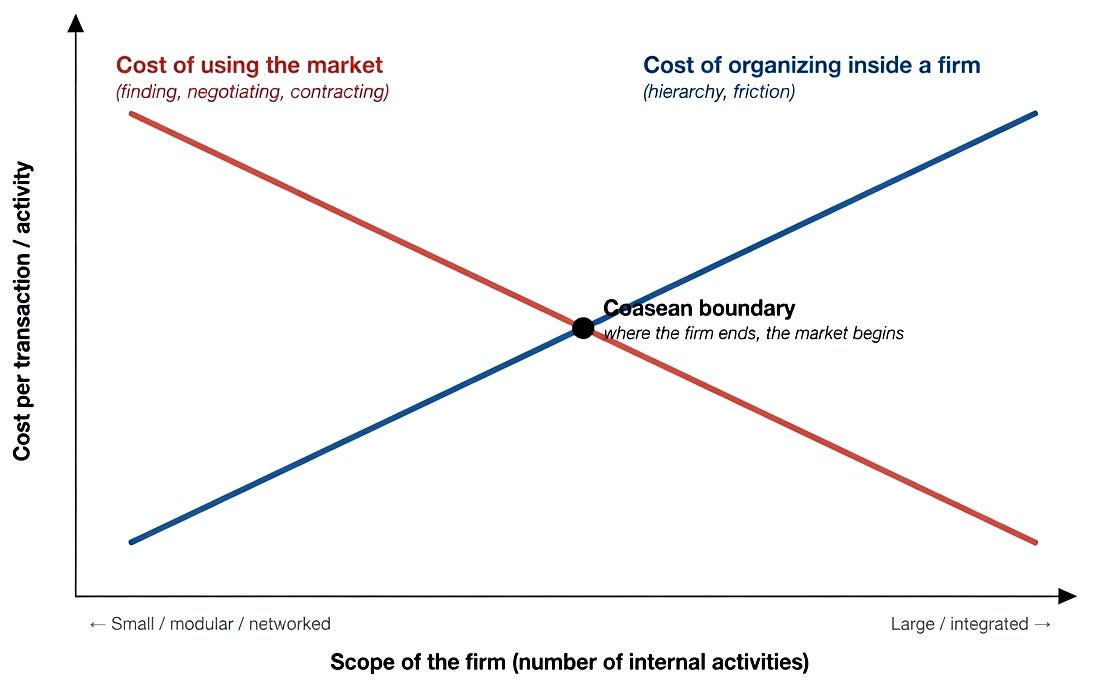
In the title of my previous piece, “Coase” refers to economist Ronald Coase. One question kept nagging him in 1937: If markets were as efficient as everyone swore, why did anyone build a firm at all? Why not just hiring every task on the open market, person by person, hour by hour?
His answer was that markets are expensive to use. Finding the right supplier takes time, negotiating takes longer, and checking the work and enforcing the contract require lawyers. That friction, which he described as transaction costs, is the reason why we build companies at all.
Inside a firm, a manager just says “do this” and skips the haggling. The task is accomplished by managerial authority.
A company will always keep growing until the cost of organizing one more task internally equals the cost of outsourcing it. That balance point determines the average company size for the better part of a century. This theory won Coase a Nobel Prize.
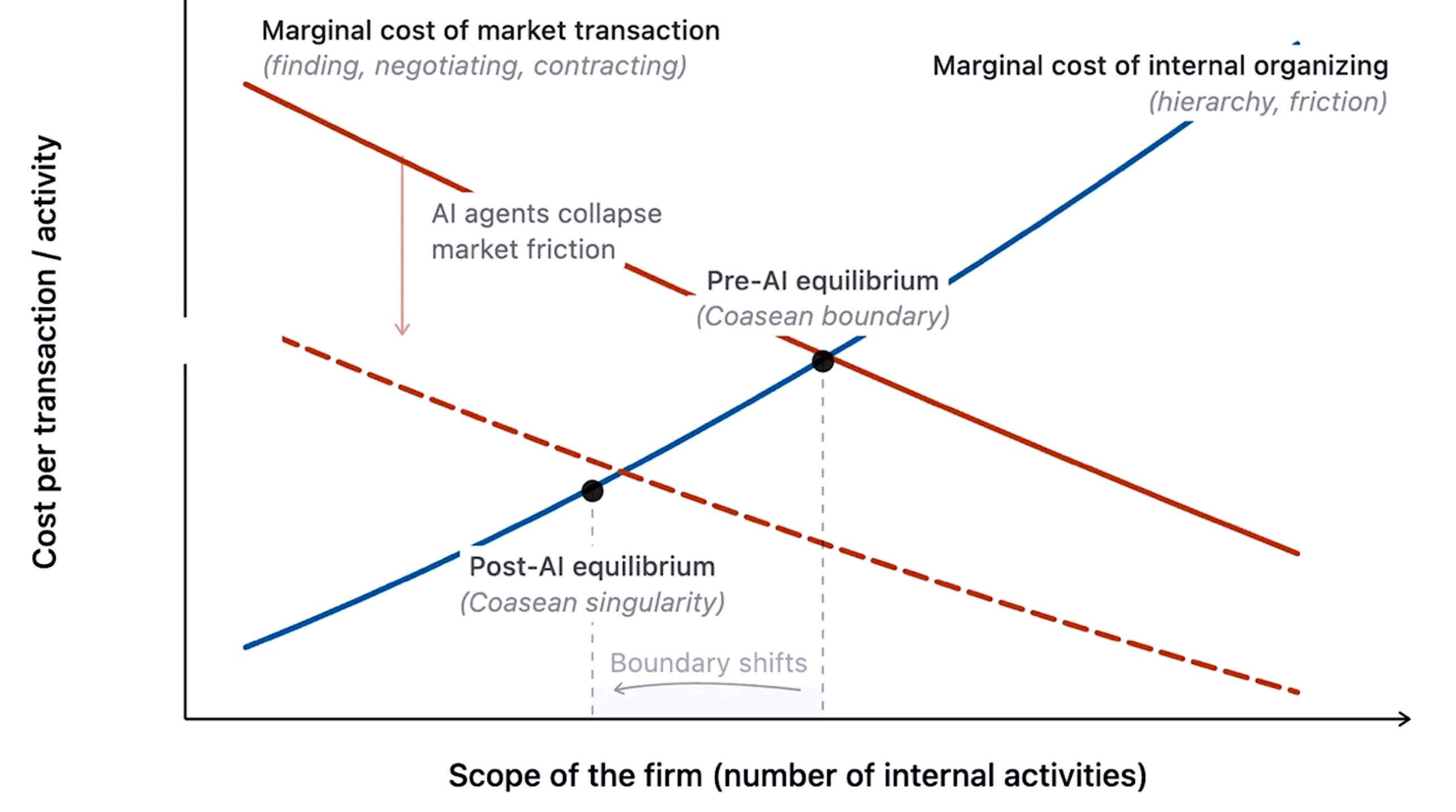
“Claude” is the other name in my essay title. It refers to an AI model, and it is my stand-in for the whole new class of agents. An agent can now handle the finding, negotiating, monitoring, contract checking, and slow and costly aspects of using the market.
That’s why the transaction costs on which Coase built his theory are now falling. And when they fall, the balance point moves. Work that had to sit inside a company, because coordinating it any other way was too hard, can be outsourced to the open market. The smallest firm that can still function keeps getting smaller. A software company that once needed 50 employees and 10,000 customers to get off the ground can now consist of two people with just a bit of startup money.
The firm does not vanish entirely. The industry, however, will fragment into smaller, looser pieces.
So in that first essay, I followed the above logic into a fashion empire (Zara versus Shein), a design-software war (Adobe versus Figma), and a Chinese appliance giant (Haier) that deliberately broke itself into 4,000 tiny enterprises. There is one common theme running across all these examples: When coordination becomes cheap, a firm stops being the only efficient way to achieve complicated tasks.
Now, that was the supply side—you know, the question about who makes things and who organizes the work. But I forgot the other side of the equation: what happens to the human who has been doing the buying. That was where my readers had been pressing me hard for an additional answer.
If you enjoyed this article so far, could I ask a quick favor? Subscribe now. It’s free and takes just seconds to sign up.
You’ll join 17,800+ other ambitious executives receiving research-backed insights delivered straight to their inboxes. Let’s keep you one inch ahead.
The agent shelf
I don’t know enough about the buyer’s half. That’s why I called Mark Greeven. He teaches with me at IMD and recently published research in Harvard Business Review, which addresses the very part that I had completely missed.
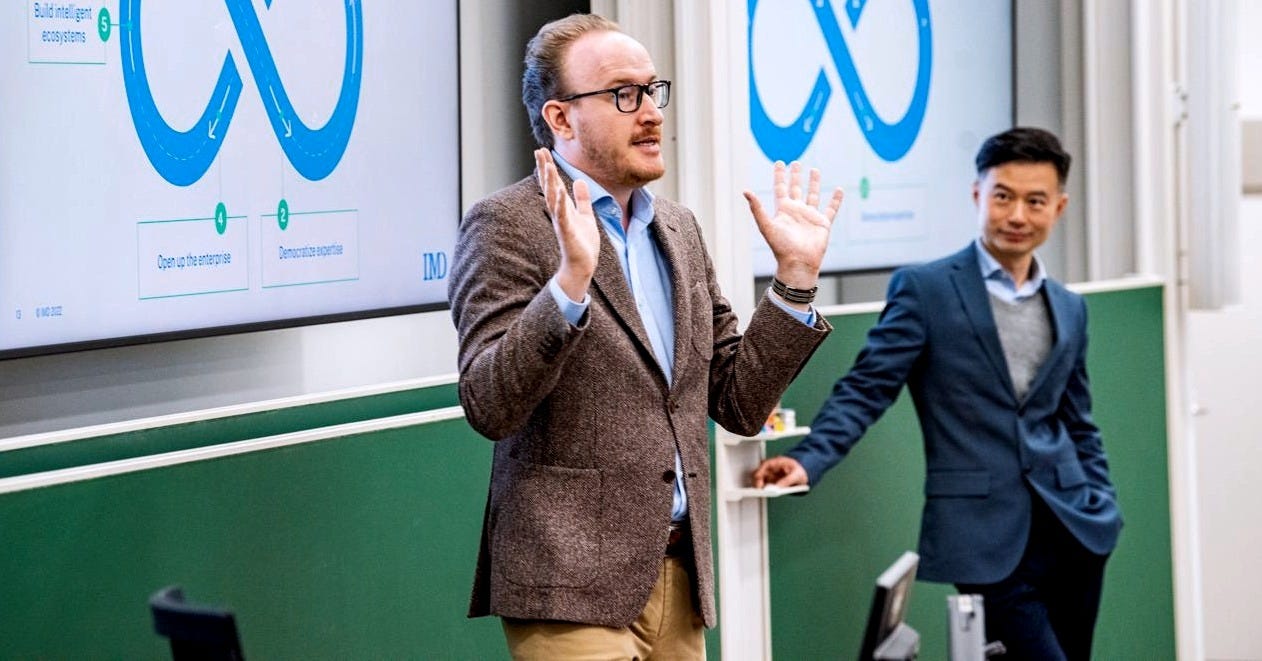
He observed that in China, agents have stopped recommending things like a chatbot would. Instead, they are already acting independently on behalf of the human shoppers. Once an agent filters the world before human eyeballs can even see the process, the marketing funnel is bypassed. Greeven calls the new battleground the agent shelf: the short list an agent picks from before you are shown anything at all.
The fight for your attention on a screen now happens another step earlier, out of your sight, between the brand and the machine.
A machine picks stuff from the shelf based on what it can measure and verify: delivery reliability, the clarity of a return policy, how fast exceptions get handled, and whether the product data is clean enough to trust. A machine doesn’t care whether there’s one click or five at checkout. The color contrast is irrelevant, and so is that cute logo on the app.
Greeven’s phrase for this is the one that I want every marketing director reading this to write down: machine-readable trust. In the old world, a brand told a story to a human. Now it starts filing a specification to an agent. Your refund policy turns into a data field, your fulfillment reliability into a percentile, and your exception handling into a number that the agent reads in a millisecond.
The marketing slogan does not persuade a machine. The machine only asks one thing: has this brand delivered its promise, transaction after transaction? No track record is bad news. A recent positive feedback beats an old one. All facts, no emotion.
Ask your team for 4 numbers a machine can verify:
On-time delivery rate,
Refund speed,
Time to resolve an exception,
Error rate in your product data.
If pulling these product data takes more than a day, you have your answer. To an agent, your brand isn’t verifiable yet.
Why China is first
Most Western executives read all of this as China pulling ahead on AI deployment. Not really. The most advanced models still come mostly from U.S. labs like OpenAI, Anthropic, and Google. Where China excels is what Greeven calls “plumbing.”
Think of it as the groundwork that the rest of the world doesn’t have yet: Alipay and WeChat Pay sitting in every pocket, dense last-mile delivery that turns a tap into a hot meal, super-apps that already span every service, and a population that trusts and doesn’t resist AI. Stanford’s 2025 AI Index put a number on that last point: 83% of people in China say that AI does more good than harm, while only 39% in the United States have the same viewpoint.
You can see what the missing plumbing costs in the West. Google has had to rally the Universal Commerce Protocol with Shopify, Target, Walmart, Visa, and Mastercard. When OpenAI let shoppers check out directly inside ChatGPT, Walmart looked at the numbers. Then it found that those in-chat purchases converted at a third of the rate of its own website because the delivery estimates were wrong and the shipping costs incorrect. So Walmart walked away, and Instant Checkout is now winding down.
I asked Greeven how far behind the rest of the world runs on agentic commerce. He said two to three years. The pipes are not laid yet.
The war over the agent layer
Now back in China, if whoever owns the agent owns the customer, then every Chinese tech platform should be fighting for that layer right now. And they are.
At the end of last year, ByteDance, the company behind TikTok, decided to put an agent inside a phone. The Nubia phone, marketed by ZTE, runs ByteDance’s Doubao assistant. The agent runs the entire phone, reaching into your messages, payments, and preferences. In China, consumers loved it. The first 30,000 units sold out before reselling at a premium. Then, within days, Tencent’s WeChat app, Alibaba’s Taobao, and Alipay all restricted ByteDance’s agent.
Officially, it was about security. But Greeven told me it was about survival. If a ByteDance agent could open any app on the phone, the customer no longer belonged to the app but to whoever owned the agent. For Alibaba and Tencent, that was the end of the world as they ran it. And hence began the first open war over who controls the agent layer. For the first time in 20 years of internet history, the prize had changed. The old wars were fought over attention: the search, the scroll, and the ad slot. This one was fought over execution, over who was allowed to act on the consumers’ behalf.
What’s left when coordination is free
So here’s the whole argument on the two sides of the equation. On the supply side, agents are collapsing the cost of coordinating work. That’s why firms fragment and why the smallest viable company keeps getting smaller.
On the demand side, people are handing off the searching, comparing, and paying to agents. The agent becomes the new coordination layer, sitting between every firm and every customer.
That is the Coasean Singularity.
Still, my readers called out that transaction costs do not completely vanish as soon as agents arrive. They said the transaction costs simply relocate. One reader, who had spent 25 years putting enterprise software into Fortune 50 companies and federal agencies, took my essay apart kindly but precisely, noting that the costs move out of human coordination and into validation, exception handling, access control, auditability, compliance, and security. Then he closed the comment by quoting Gandhi: “There is more to life than increasing its speed.” He was right.
A firm has never existed just to coordinate cheaply. It exists to absorb risk: to carry a brand you can still trust when the internet fills with AI-generated noise, to leave an audit trail, to be the last resort that answers for the liability when things go wrong, to hold enough capital to survive failures of business experimentation.
When coordination falls to near zero, what remains is risk. Those who solve trust at machine scale becomes the big firm of tomorrow.
Bring this to your next team meeting. Draw 2 columns.
Left: everything that the company does to absorbs risk. The brand customers trust, the audit trail, the liability the company answers for, the capital that survives failed experiments.
Right: everything that the company does to merely coordinate. Agents will do the right column cheaper.
The left column is the company.
For me, the best part of writing the first essay was that not everyone agreed with me. With your deep comments over about a week, people like you sharpened my thinking and made my next argument better. So my commitment is to continue doing this.
The video at the top is the more entertaining version of the text you just read: about 26 minutes, the cafe in Shanghai, Coase, the conversation with Mark, and the agent-layer war.
If you are building agentic commerce, redesigning a firm around it, or watching it from inside a company that still believes it controls the marketing funnel, tell me what I am missing. Oh, and send this to someone who will find it helpful or push back harder, and leave a comment of your own.
I read every one, and the best of them will, of course, inspire my next essay.
Stay future ready. One inch ahead.
— Howard


