
The Cell That Didn't Catch Fire
Inside BYD’s Showroom — and the Thirty-Year Odyssey That Built It

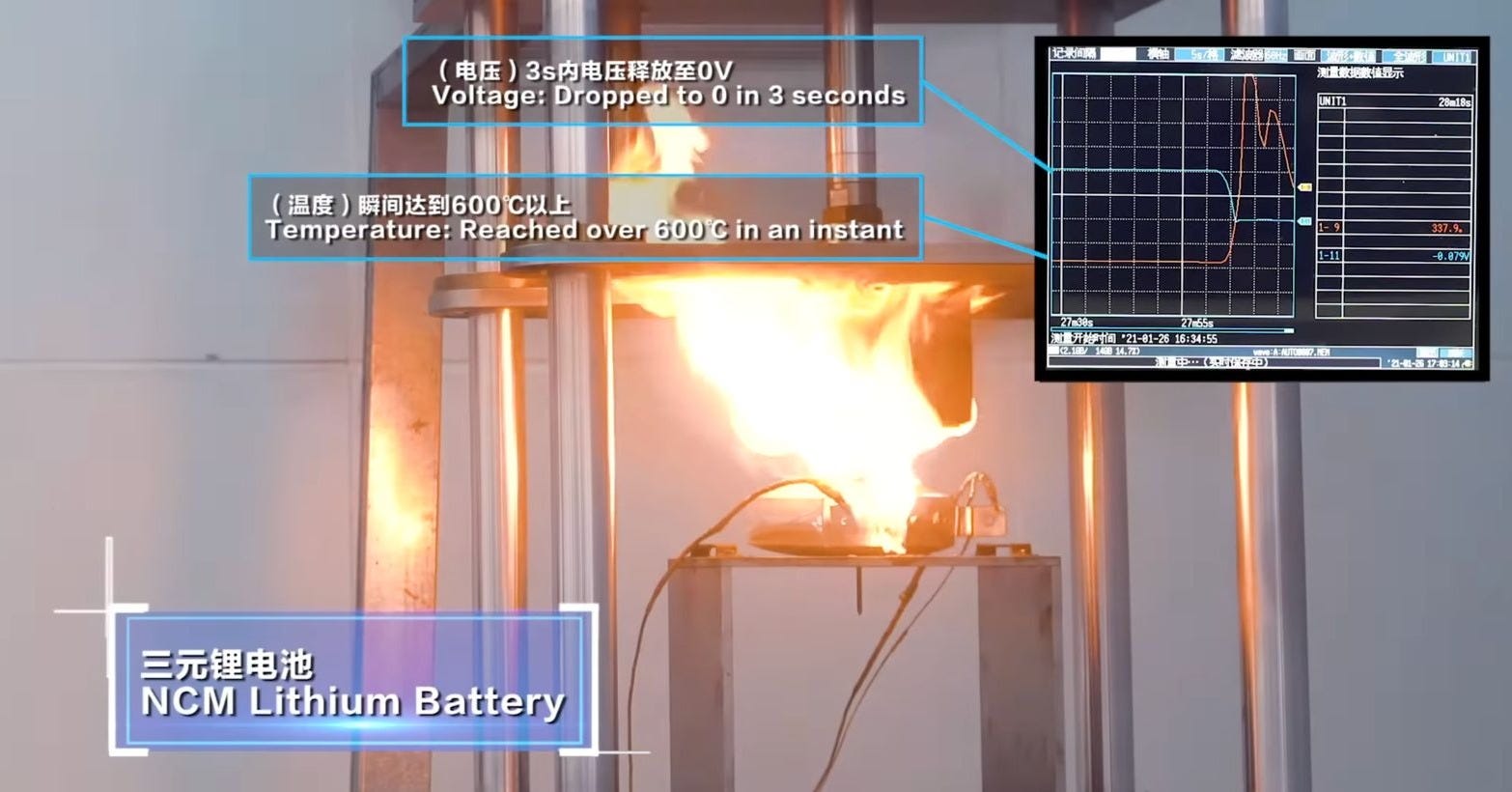
The nail is six inches long. Sharpened to a surgical point. Mounted on a hydraulic press behind plate glass. The press drops slowly enough that you can count your own heartbeat between the moment it touches the battery cell and the moment it punctures the casing.
I am standing in BYD’s visitor’s center in Shenzhen, February 2026, shoulder to shoulder with executives from one of Europe’s largest industrial conglomerates. Nobody speaks.
Two batteries sit side by side. The first is a standard ternary nickel-cobalt-manganese cell, the kind of chemistry that once powered most of the world’s electric vehicles. The nail breaks the surface. Half a second passes.
Then a guttural whoomp hits the air, and the cell detonates into thermal runaway. Flames lick upward. The thermal camera overhead floods white: surface temperature past 500 °C. Black smoke rolls against the glass. The executive next to me steps back and touches his collarbone.
That kind of cell had been mounted beneath the passenger seat of a car.
In 2012, a speeding Nissan GT-R slammed into a BYD e6 taxi in Shenzhen. The battery ruptured. Fire consumed the cabin. Three passengers died. The public backlash was severe. BYD’s stock dropped.
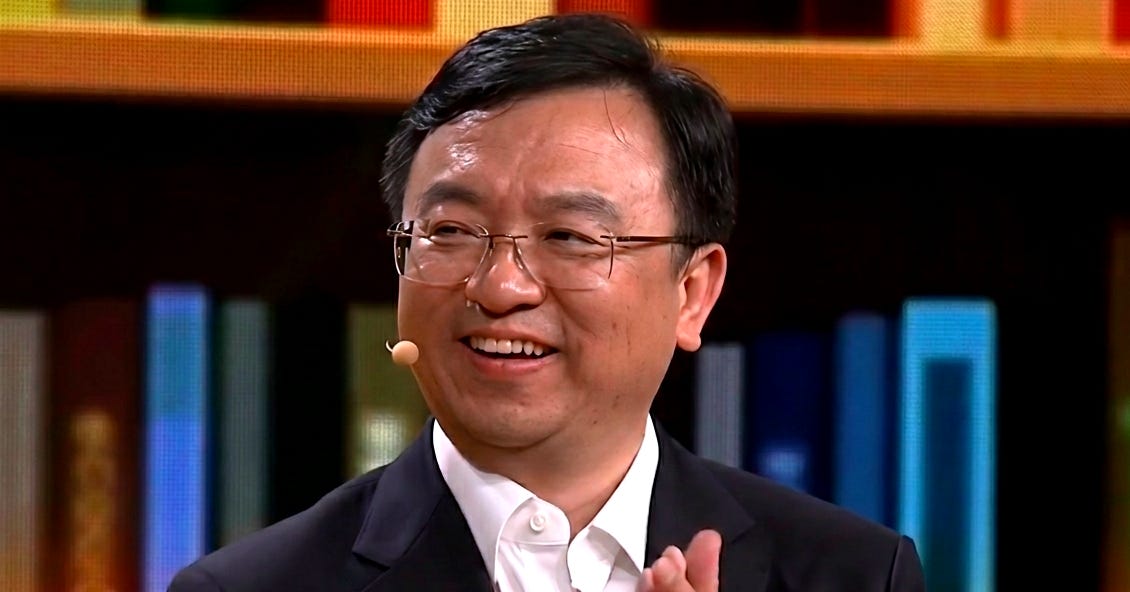
Wang Chuanfu, BYD’s CEO, barely slept for weeks. Three passengers, all in their twenties. His chemistry. His cell. His company’s name on the casing. He had not built it to kill anyone, but it had. He pulled his engineers together with one question: What is the mechanism by which this cell fails, and how do we make that physically impossible?
That question would consume eight years of R&D. A lab burned during the process. The team lost equipment, prototypes, months of iteration. What they did not lose was the data. They rebuilt. They ran the test again. And again. Hundreds of times. Each failed cell was, as one engineer put it, “a treasure for the research staff”: a lesson in physics waiting to be read.
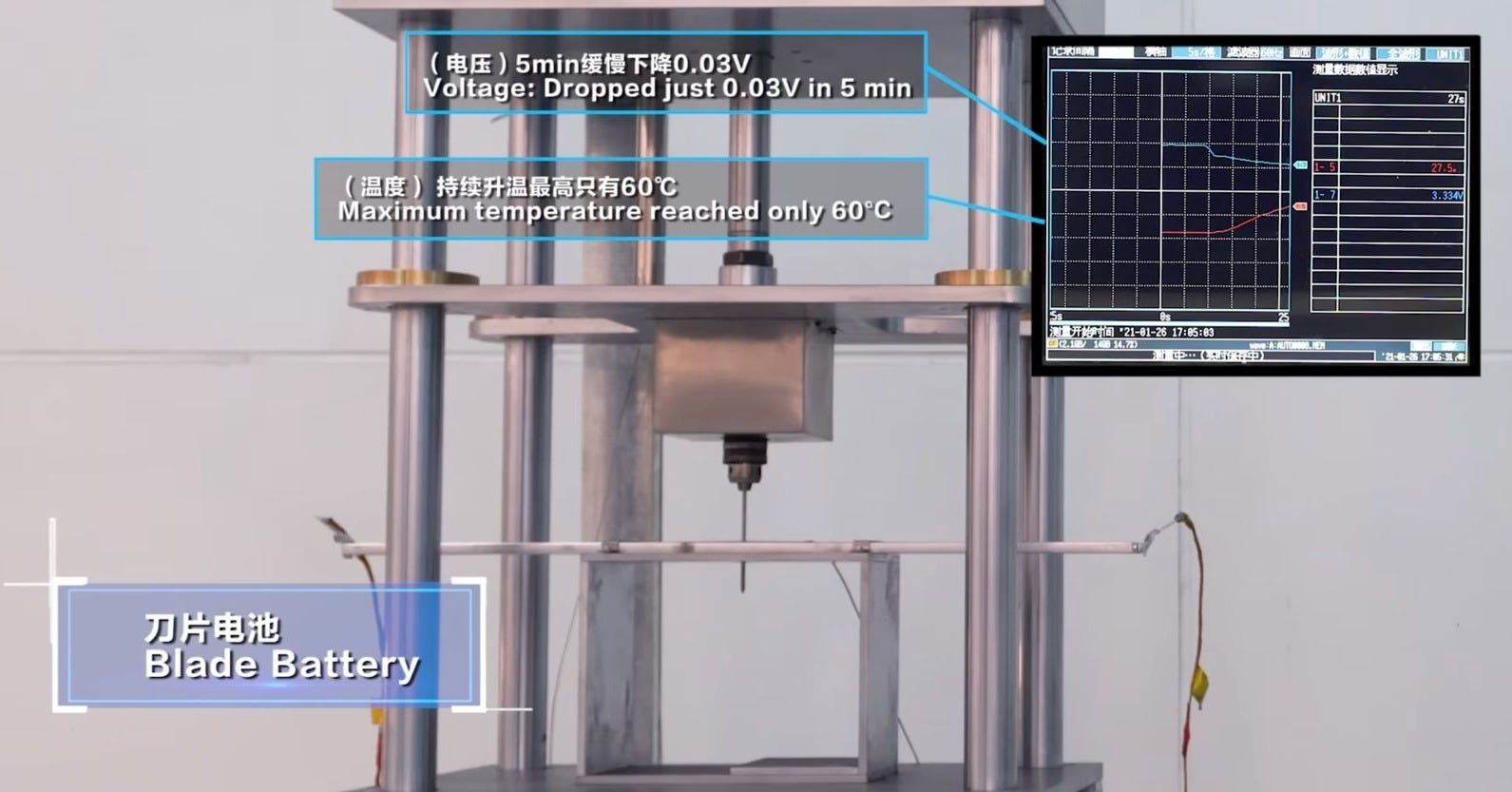
The technician resets the press. The second cell is longer, thinner. A pale rectangle 960 millimeters long, just 13.5 millimeters thick. Roughly the proportions of a sword blade. BYD’s Blade Battery. Lithium iron phosphate, in a geometry that changes everything.
The nail descends. Punctures. Nothing happens.
No smoke. No spark. The thermal camera stays cool blue: 30 to 60 °C. You could rest your hand on the surface.
Around me, several visitors are writing in their notebooks. Fast.
The Blade Battery was born from grief. It was engineered by people who had watched their own lab burn, and who decided, with a resolve that borders on the religious, that it would never happen again.
I walked into this building expecting to see electric cars. I walked out understanding why the global auto industry is running out of time to respond.
The Orphan’s Wager
To understand what I saw, you have to rewind three decades, to a country and a company that looked nothing like this. Wang Chuanfu was born in 1966 in a village outside Wuhu, Anhui province, one of the poorest regions in eastern China. His father was a carpenter who made furniture and coffins. Wang was the youngest of eight. His father died when Wang was in primary school. His mother followed a few years later. By fifteen, both his parents were gone.
His older brother and sister-in-law, themselves barely scraping by, made a decision: the boy would stay in school. Every other sibling had dropped out to work. Wang Chuanfu would be the family’s one bet.
He studied metallurgical physical chemistry. Earned a master’s at Beijing’s General Research Institute for Nonferrous Metals. By twenty-six, he was the youngest department head the institute had ever appointed. He published research on rechargeable batteries at a time when rechargeable batteries were an exotic Japanese monopoly. Sanyo. Sony. Panasonic. Their clean-room production lines cost hundreds of millions of dollars. The capital barrier alone would have stopped most people from even thinking about it.
Wang was not most people.
He quit his government post. His colleagues thought he was insane. The stable salary, the title, the thing a family sacrifices everything to secure. For what? But his cousin loaned him the startup capital.
On November 18, 1994, a team of roughly twenty people gathered in a three-story building in a newly built industrial zone in Shenzhen. Registered capital: 4.5 million yuan. Workers ate in a narrow passage between a factory building and a kitchen; when there weren’t enough tables, they squatted to eat. The dorm was seven stories high. The rooms had no hot water. Company name BYD: “Build Your Dreams.” At the time, it sounded aspirational to the point of comedy.
Human + Fixture = Robot
Japanese battery lines were fully automated. One production line cost 25 to 30 million yuan. Wang had a budget of three million. He couldn’t afford a single machine.
So he sat down and asked a question: What, exactly, does each machine do?
The answer: a machine picks something up, positions it precisely, and puts it down. Over and over. The precision comes from the jig, not the arm. If you design a jig that holds the component in exactly the right position, a human hand can do the rest.
He wrote an equation on whiteboards across the factory floor:
Human + Fixture = Robot
His engineers broke the automated process down into dozens of steps. For each step, they built a custom jig that constrained the worker’s motion to the same tolerance the machine would achieve. The cost: one tenth of the Japanese line. The quality: comparable. And in 1990s China, labor was the one input that was functionally unlimited.
By the late 1990s, BYD was mass-producing lithium-ion batteries. The international price was eight to ten US dollars per cell. BYD sold theirs for three. Wang traveled personally to Beijing University, Tsinghua, and his alma mater, Central South, to recruit PhD students. By 1998, BYD’s research institute had over two hundred researchers working with equipment that cost more than some of his production lines. He told his team: “Technology is king. Innovation is the foundation.” He meant it literally.
The Auditors and the Spoons
In 2000, Motorola was looking for a new battery supplier in China. Wang Chuanfu had been preparing for exactly this moment. The audit team arrived at BYD. They stayed nearly half a year. Six people. Supplier quality engineers, or SQEs, paid to crawl through a factory and rebuild it to Motorola spec.
Wang held daily meetings with his team to discuss what the auditors had found, how BYD would meet each standard, how to go beyond it. One, a Singaporean who had worked inside Motorola’s own plants, said he was stunned by the speed of improvement. A problem identified on day one had a root-cause analysis by day two and a permanent fix by day three. Japanese and Korean suppliers, he said, took weeks.
The Motorola auditors handed Wang a book. Hundreds of pages. The QSR manual: Quality System Requirements. Wang had it translated overnight and shoved into every supervisor’s hands. BYD swallowed the whole thing.
Promotions required a green belt, statistical process control, and FMEA — failure mode and effects analysis. And the 8D discipline came with hard clocks: twenty-four hours for a first response, forty-eight for containment, five days for root cause. Before long, BYD won Motorola’s “Best Supplier” award. It was on par with the Japanese giants.
If you enjoyed this article and it brought you clarity, could I ask a quick favor? Subscribe now. It’s free and takes just seconds to sign up.
You’ll join 15,000+ ambitious managers and CEOs receiving exclusive, research-backed insights delivered straight to their inboxes. Let’s keep you one inch ahead.
Then Nokia came to visit. Their team was appalled. Electrode material was being ladled out of vats with kitchen spoons. Workers in rubber gloves operated machines that looked like repurposed sewing equipment. Some visitors refused to believe quality products could emerge from such conditions.
But the data were the data. Nokia sent batteries to its testing facility in Finland. Japanese manufacturers achieved roughly 300 charge-discharge cycles before their cells degraded. BYD’s hand-built cells delivered over 1,000.
Nokia placed the order.
Behind that gap between how BYD looked and what BYD could do was a methodology that bordered on institutional religion. When defective cells appeared, Wang asked: “Have you found the root cause?” If yes: “Can you reproduce it?” Then the demand: “Make one hundred cells with exactly the same defect. If you can reproduce the failure one hundred times, identically, then and only then have you understood the mechanism.”
That practice, reproducing failure on purpose until the physics revealed itself, became the bedrock of BYD’s entire operation. Wang’s own desk, for years, was covered with dismantled battery cells, their innards pinned open like specimens in a biology lab.
The most important capability BYD ever built was not a battery. It was the ability to learn from customers who were more sophisticated than they were, more quickly than anyone thought possible, and then convert those lessons into permanent institutional knowledge.
That ability is available to you, too. You do not need a clean room. You just need the willingness to be the least impressive person in the room and study everything the room teaches you.
Climbing the Disruption Ladder
Clayton Christensen described how disruptive companies enter markets at the bottom, aiming at customers the incumbents don’t care about. Then they improve. Relentlessly. Until one day they are eating the incumbent’s lunch at the high end. The incumbent never sees it coming because, at every decision point, they made the rational choice.
BYD didn’t climb one ladder in one market. It built a new ladder, rung by rung, across multiple industries. And each rung was invisible to the people it would eventually surpass.
Phone batteries were the first rung. E-bikes and scooters were the second. Municipal bus fleets were the third, and the most punishing: stop-start cycles all day, extreme temperatures, drivers who are not gentle, passengers who overload them, sixteen-hour service days. Those buses ran London’s double-decker routes. They climbed the Andes. They survived winters in Helsinki. Every bus that made it through Manchester or Bogotá was a data point. By 2017, Shenzhen became the first major city on earth to operate an entirely electric bus fleet: over 16,000 vehicles, the majority BYD.
Commercial delivery vans were the fourth rung. Then passenger cars. Then hypercars.
Each rung was boring. Each rung was unglamorous. Each rung gave BYD capabilities that no competitor possessed in combination.
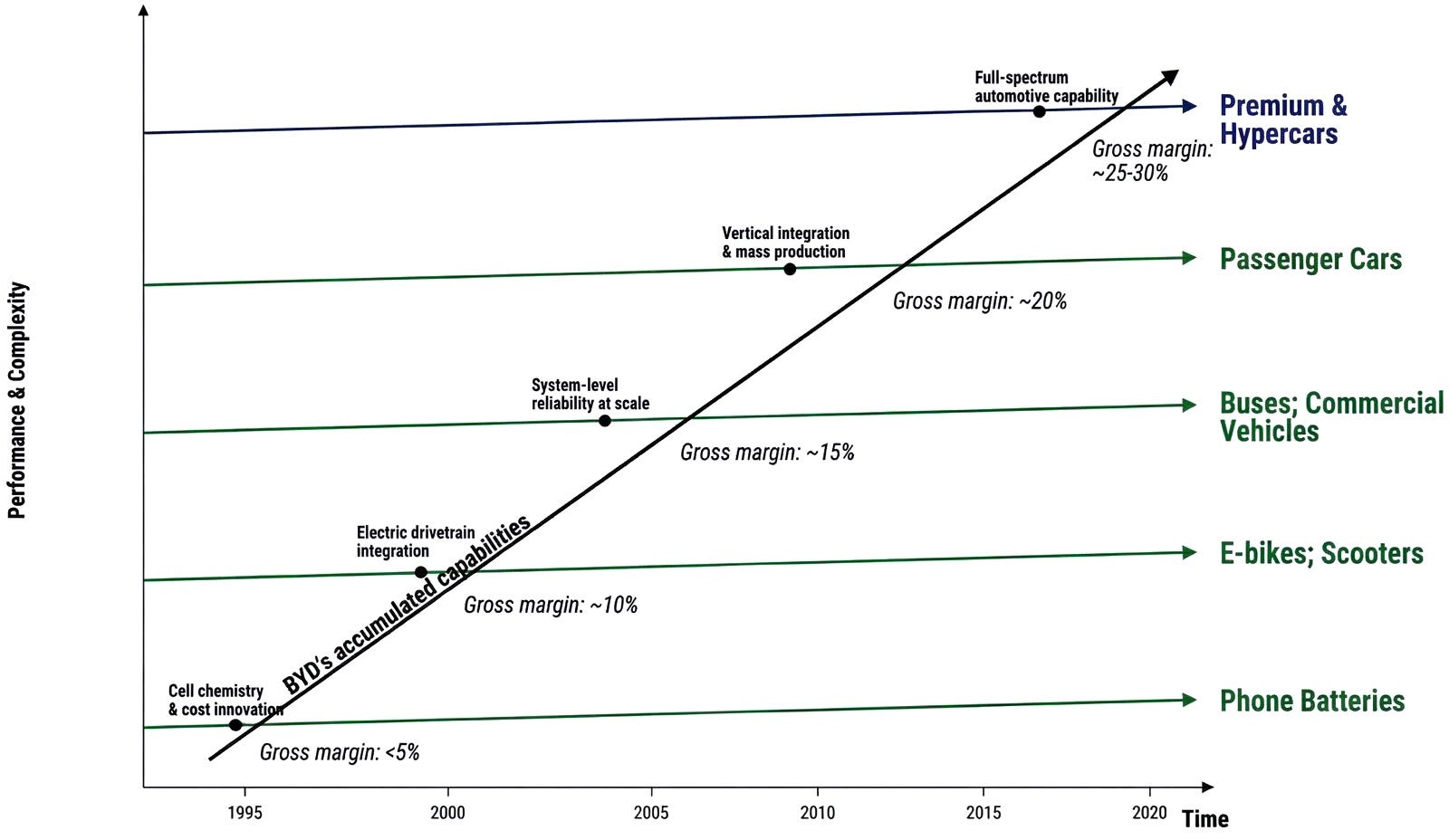
At every stage, Western incumbents had the opportunity to respond. At every stage, they made the rational decision not to. Consider the view from Detroit or Munich in 2010. Your engineers tell you electric vehicles are a decade away. Your margins on combustion SUVs are fat. A Chinese company nobody has heard of just launched a plug-in hybrid that sold four hundred units. Ignoring BYD is the correct decision.
Christensen called this the “asymmetry of motivation.” The incumbent has every reason to keep doing what it’s doing. The disruptor has every reason to keep climbing. By the time the curves cross, it is too late.
Your competitors’ rational decisions are your greatest advantage. If you are building something disruptive, stop worrying about whether the incumbents will copy you. They won’t. Not because they’re stupid. Because they’re rational.
Their rationality is your runway.
496.22 Kilometers per Hour
Back in the showroom. I am standing in front of a car that looks like someone crossbred a Lamborghini with a spacecraft. Low. Wide. Menacingly sleek. The Yangwang U9.
On September 14, 2025, at Germany’s ATP track at Papenburg, driver Marc Basseng pushed it to 496.22 km/h (308 miles per hour). Independently measured. The fastest production car ever clocked on Earth.
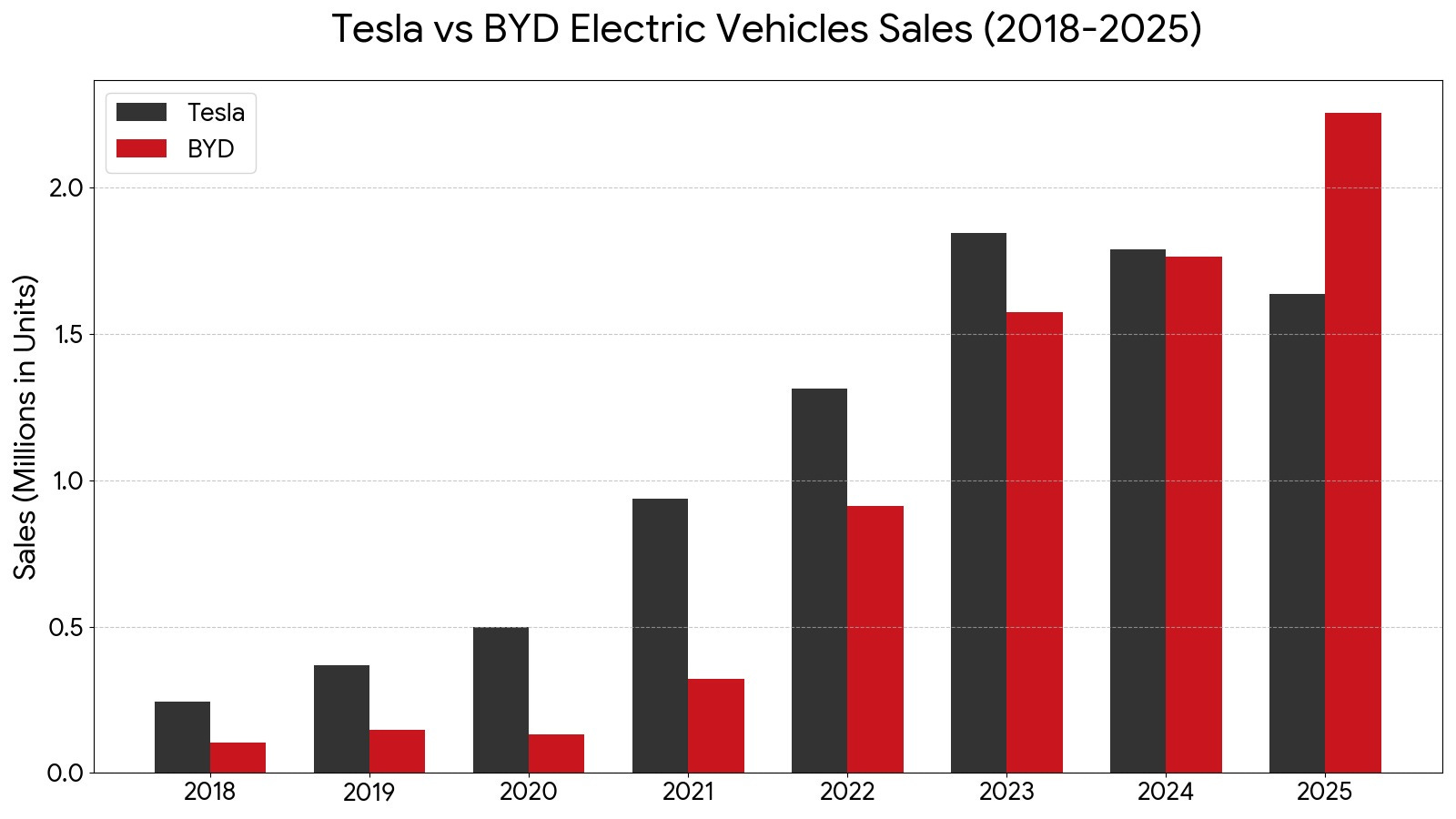
In 2011, Elon Musk was asked on Bloomberg whether BYD could ever rival Tesla. He burst out laughing. “Have you seen their car?” he said.
The answer to Musk’s question is now 496.22 kilometers per hour.
Between 2010 and 2020, China’s electric vehicle boom looked like a gold rush. Nearly 500 companies rushed in. Subsidies were generous. Capital was cheap. Everyone had a slide deck. Most are now gone. Byton — backed by Tencent and Foxconn, led by ex-BMW and ex-Nissan executives — raised more than $1.2 billion. It never delivered a car to paying customers.
And in 2019, one of the darkest years in BYD’s history, net profit was a mere 1.6 billion RMB. Subsidies had been slashed. The stock was languishing. Early sedans had been dismissed as taxi-grade. Plasticky interiors, forgettable design, the kind of car you rode in but never chose. Wang’s response? Invest 5.6 billion in R&D. More than three times the profit, poured back into research. Technology is king. Innovation is the foundation.
Then COVID hit. China needed 50 million face masks per day and could produce barely 20 million. The bottleneck was meltblown fabric, the electrostatically charged layer that makes an N95 an N95. Without it, a mask is just cloth.
BYD had never made a single mask.
Wang called it the Battle of a Hundred Regiments, a deliberate echo of a famous wartime campaign. Engineers were pulled from 15 divisions — battery, electronics, automotive, molds, precision manufacturing. Each unit got a production target.
This was the reflex, drilled over decades. If you understand the physics of a process, you can build anything at scale. In three days, teams reverse-engineered a mask line from first principles: servo systems, ultrasonic welding, tension control, inline inspection. Two groups were told to race. Five million masks a day each. The losers would buy dinner.
By April, BYD was producing 100 million masks per day. Equipment designed in-house. Tooling built in-house. Packaging automated in-house.
The critics noted that some early batches failed FDA certification and were returned by foreign buyers. The speed came at a cost. But the underlying capability was real. From zero to the largest mask manufacturer on earth.
I tell this story not because it’s about masks. What BYD demonstrated was the reflex: break the problem into physics, build the tooling, iterate at inhuman speed, then scale.
“One is one; two is two; you have it or you don’t; it works or it doesn’t.” Wang would tell his engineers. That discipline of sticking to principled thinking is how you get through obstacles.
Swimming, Flying, Dancing
Back in the visitor’s center. The demonstrations kept coming.
The Yangwang U8 is an SUV the size of a Land Rover. When its sensors detect water rising past the door sills, the vehicle seals itself. Air suspension rises to maximum height. The drivetrain switches modes.
And then it floats.
The four-wheel motors spin slowly, like paddle wheels, propelling the two-ton vehicle across water at three kilometers per hour. I asked the guide why BYD built a floating car. His answer: “We asked ourselves what would kill our customers. Floods kill people. So we built a car that floats.”

Then a DJI drone launched from a roof-mounted hangar, filming the vehicle in 4K while tracking it at highway speed. When the battery ran low, it returned and docked itself for recharging.
Next a U9 rolled to the center of an open lot and, on command, lifted all four wheels off the ground. It hovered, bounced, and settled back. In footage shown alongside, the same car hit spike strips at 120 km/h and launched itself over them. In another clip, a wheel was physically removed. The car kept driving on three legs. In a marketing video, passengers applied eyeliner while the car crossed rough terrain. Their eyeliner did not smudge.
Underpinning all of it: each wheel has its own motor controlled by its own inverter, running on BYD’s own chips, coordinated by BYD’s own software. The company that had made phone batteries had now designed the chip, built the motor, written the software, and manufactured the car. All under one roof.
When I looked around the room, several of the European executives had stopped writing. They were just staring.
In 2024, BYD invested 54.2 billion RMB in R&D. Its global workforce reached one million. Over 110,000 work in research and development.
That is not a department. That is a city of engineers.
What the Nail Teaches Us
I have replayed that nail test in my head many times since leaving Shenzhen. The nail does not care about your brand heritage. It does not care about your stock price, your celebrity endorsements, or how many decades your founding family has been in the automobile business. The nail cares only about the chemistry of the cell it is about to puncture. Either the cell catches fire, or it does not. Physics does not negotiate.
BYD did not decide one morning to build the fastest car on Earth. First, it built phone batteries. Then E-bike packs. Bus systems. Delivery vans. Passenger cars. Hypercars. Each rung taught something the previous rung could not. There was no quantum leap. Only the next rung.
And Wang’s deepest insight had nothing to do with batteries. It was about knowledge. If you cannot reproduce a defect one hundred times, identically, you do not understand the mechanism. Do not settle for a plausible explanation. Demand a reproducible one. The difference between the two is the difference between an organization that keeps making the same mistake and one that never makes the same mistake twice.
The cell that did not catch fire is not exciting. Nobody films a TikTok about lithium iron phosphate chemistry. But it is the foundation upon which everything else — the floating SUV, the 496 km/h hypercar, the 100 million masks — was built.
Every career has its Blade Battery. The part nobody photographs. The part everything else sits on. What is yours?
In 2011, Elon Musk asked: “Have you seen their car?” I have now.
The next time I feel the pull to skip the fundamentals, I will think about the nail. The cell that caught fire and the cell that didn’t.
And I will ask myself: which one am I building?
A truly great article, informative, entertaining, riveting. Congratulations on a job very well done.
Thanks, Howard, for another very thoughtful and quite simply compelling analysis. As others have surely told you, answers lie in our stories, and so often, in yours.
When told honestly, I believe true progress for humanity is achievable. If we lose our ability to tell and learn from these stories, or try to make up phony ones to hide our incompetence or simple lack of success behind politics, posturing, or just choosing powerful allies in the hope nobody notices, we've lost our future.
It's clear to me that BYD is not perfect by any measure. But boy, are they trying to do things right and listening to their customers and "smarter people" they're not afraid to acknowledge as such. And that humble, if always disciplined approach to quality and relentlessly repetitive testing is as good a start (and tonic and driver of positive possibilities for future operations) as any company or organization could aspire to. I just hope they're rewarding their employees, customers, and communities where all work with authentic and lasting encouragement and real incentives to keep going toward a brighter future for humanity. Otherwise, why bother, in the end?